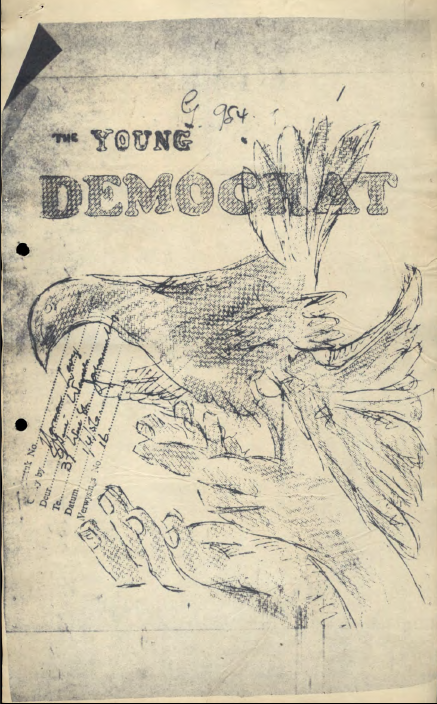
The Young Democrat
The Young Democrat was a small magazine produced in Johannesburg around 1956 by “a group of girls and boys, ages ranging from 10-14 years” who “disagree with the Government and believe that Peace, Freedom and Equality should reign”. This homespun and informal little political magazine was ‘roneoed’ (stencil duplicated), part typewritten, part handwritten, and hand-illustrated. It seems to have run for only two issues. Its editors and contributors were members of the ‘Young Democrats’, children of members of the Congress of Democrats, founded by white radicals in 1952 when the Communist Party was banned. They included Barbara Harmel (daughter of Michael Harmel, a prominent theoretical voice in the Communist Party) and Ilse Fischer (daughter of the Communist lawyer Bram Fischer). The magazine reported on the activities of the Young Democrats, published poems and stories by international leftist writers, and disseminated the principles of the newly-adopted Freedom Charter. It formed part of the larger print ecosystem of the Congress movement which included Liberation, Fighting Talk, Counter Attack, Isizwe, Inyaniso, African Lodestar, Worker’s Unity, New Age and Advance. It was a highly mimetic little magazine and its young contributors copied elements of the leftist periodicals, especially New Age and Fighting Talk, that their parents read and wrote for, and which they repeatedly recommend to their own young readers. It also closely resembles other youth magazines from the Congress movement, especially New Youth, the magazine of the Transvaal Indian Youth Congress. Despite this copying, the magazine is not a stale reproduction of adult periodicals. Precisely where the young editors were literally copying their parents’ radical magazines, differences become legible and countervailing normative pressures reveal themselves: differences between the youth magazines and the adult periodicals, but also between the youth periodicals themselves, despite their resemblance. The magazine, along with many other Congress aligned publications, was used as evidence by the state in the 1956 Treason Trial and copies are held in the archives of the trial at Wits University. It seems to have been included with the intention of intimidating Bram Fischer, who was a member of the defence team. The Young Democrat appears on the evidence list with a handwritten note in the margin: “(Bram’s baby)”. Without the pettiness of the apartheid regime, very little record might have remained of this ephemeral magazine, which reflects a brief moment of one segment of leftist youth culture in 1950s South Africa.
Rikus van Eeden is a postdoctoral researcher in philosophy and literary studies at the Centre for Literary and Intermedial Studies (CLIC), Vrije Universiteit Brussel, where he works on the AFROPRESS project funded by the European Research Council. AFROPRESS is an interdisciplinary research project studying periodicals from Sub-Saharan Africa published between 1918-68. His own research focuses […]