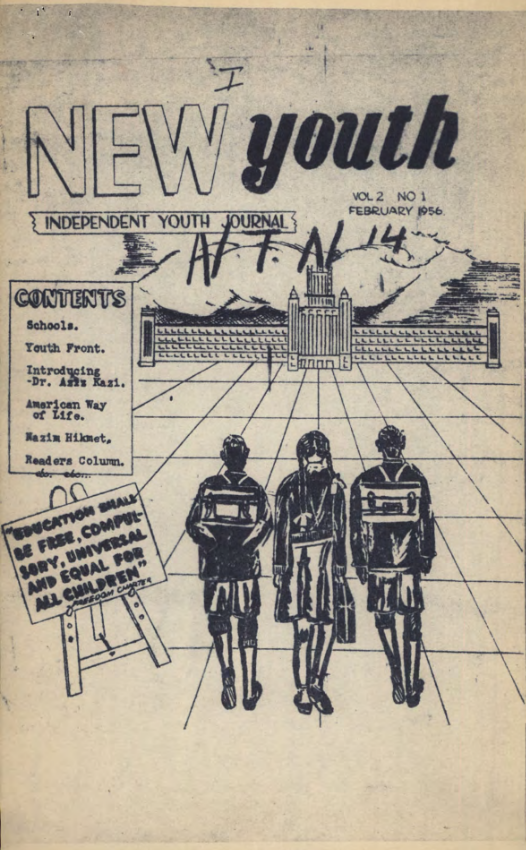
New Youth
New Youth was the magazine of the Transvaal Indian Youth Congress, based in Johannesburg. It forms part of the broader print ecosystem of the Congress movement in the 1950s. Most of the articles in the magazine appear under pseudonyms like Spartacus, Johnny Youngman, and Leftie, though the names of TIYC members like Moosa ‘Mosie’ Moolla also occasionally appear in its pages. The magazine was highly mimetic and copied elements of other leftist, Congress-aligned magazines such as New Age, Fighting Talk, and Worker’s Unity that played an important role in the print culture of the nascent anti-apartheid movement. It was a homespun and informal production, with illustrations hand-drawn and copies made by roneo (stencil duplicator). Visually, it very closely resembles, The Young Democrat, a magazine run by the children of white radicals which seems to have drawn its inspiration from New Youth. This mimicry was formal, material, and semantic: with graphical elements ‘roneod’ or copied by hand, comparable topics covered, similar tones of reportage, etc. This propensity to copy makes these magazines interesting to consider in relation to one another. New Youth is more radical than The Young Democrat, a fact reflecting the racial positionality of its contributors (they were directly touched by the more brutal aspects of apartheid policy) but also the fact that they were slightly older. While it often focused on issues that mattered to high-school students and the youth more broadly, these were treated for their political significance with reference to apartheid social engineering. The journal documents, for example, the way in which moving Indian schools from one neighbourhood to another constituted a first step in the regime’s schemes to displace whole communities. It disseminated information about the activities of the TIYC as well as the broader Congress movement, publicized the principles of the newly-adopted Freedom Charter, published poetry and stories by international leftist writers, and analysed the lived experience of the early years of apartheid from the perspective of the youth. New Youth also demonstrated affiliations to the local community, featuring ads from Indian run businesses in and around Johannesburg; such as ‘Cisco’s’ advertising “Potato Crisps, Salted and Curried Peanuts”, as well as “the latest Indian, English and Afrikaans records”. The magazine offers a glimpse into the everyday lives of young leftist South Africans of Indian descent: their politics, but also their dances, their sports interests, and the neighbourhood shops they might have frequented. The magazine, along with many other Congress aligned publications, was used as evidence by the state in the 1956 Treason Trial and copies are held in the archives of the trial at Wits University.
Rikus van Eeden is a postdoctoral researcher in philosophy and literary studies at the Centre for Literary and Intermedial Studies (CLIC), Vrije Universiteit Brussel, where he works on the AFROPRESS project funded by the European Research Council. AFROPRESS is an interdisciplinary research project studying periodicals from Sub-Saharan Africa published between 1918-68. His own research focuses […]