▴ 305
▴ 305
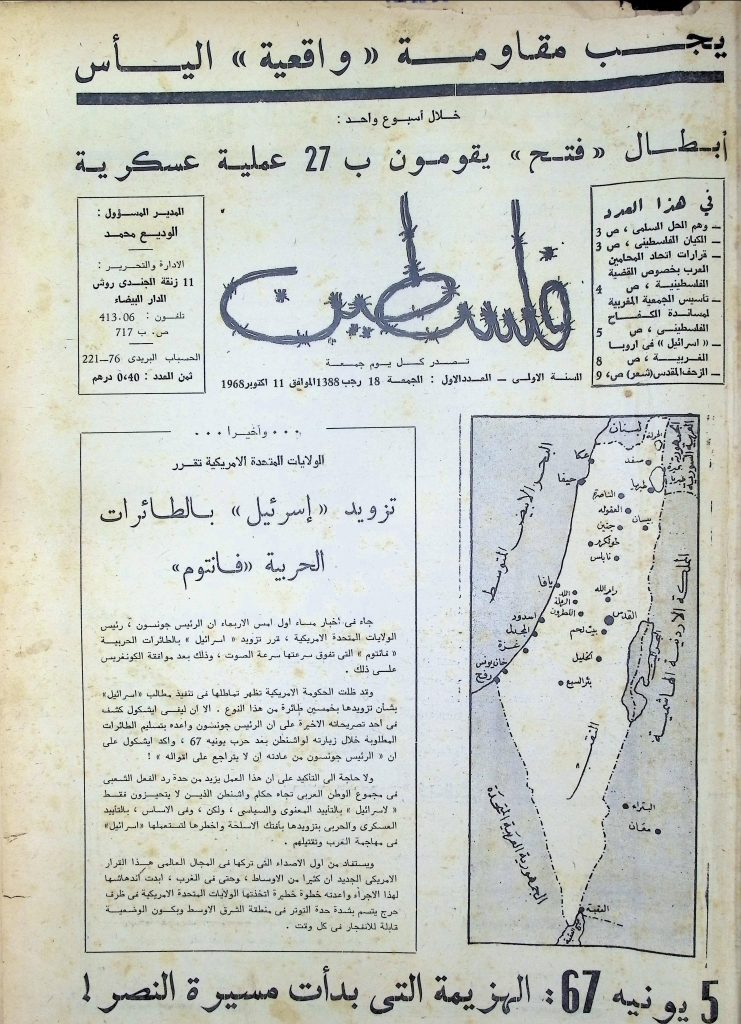
فلسطین : Phalastine
This contribution draws on an ongoing research & archival project on radical publishing in Morocco, during which we came across an ad in Souffles (1969) that read “PHALASTINE: a Moroccan weekly entirely dedicated to the Palestinian struggle published every Friday: news, accounts, analysis and documents on the struggle”. No one we knew had ever seen it, and finding traces of the newspaper in public or private archives proved challenging, transforming its very absence into a provocation, a gathering place, a spectral refusal to let us give up on solidarities past. In November 2023, the normalised silence in these parts called for our own refusal: student, activist, artistic circles had resisted in the 60s-70s, and through both archival and contemporary f/ philes, we would interrogate, and reactivate this insurgent memory.
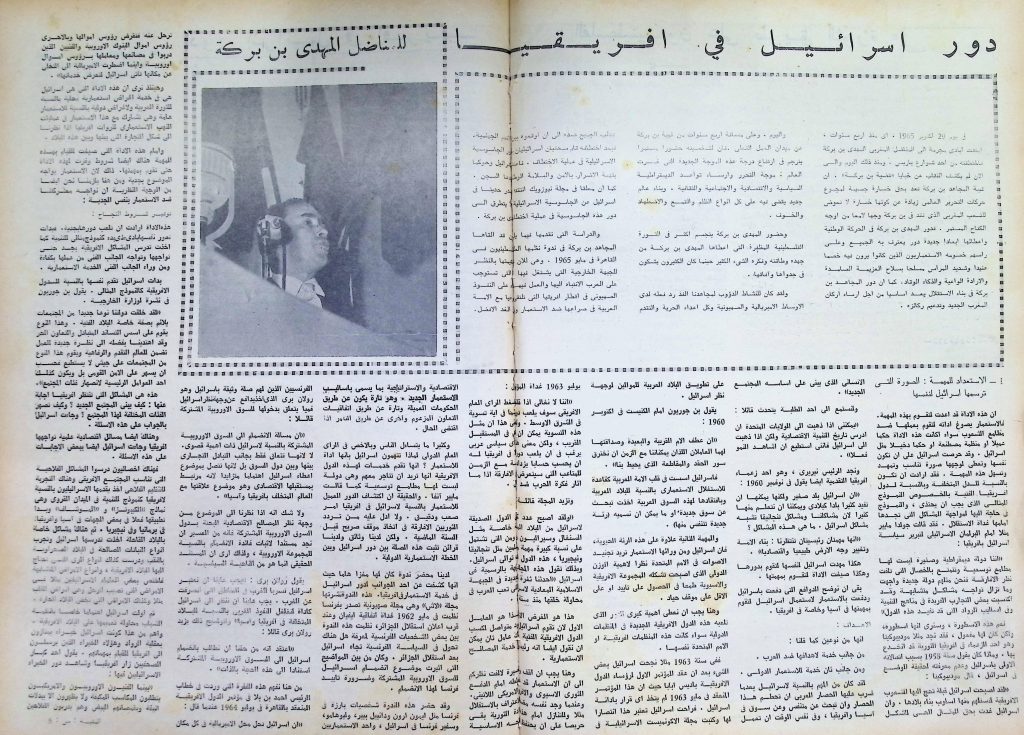
What began as an engagement with absence and “critical fabulation” to imagine what we could not find, took a more classic archival turn. Friends helped us locate the newspaper hidden away in Al Itihad Ishtiraki library. Phalastine was a 16-page weekly Arabic-language newspaper published by Les Editions Magrébines in Casablanca, that circulated across Morocco from 1968 to 1971. Its editor-in-chief was Mohammed Ouadie Al-Assafi and while it was not officially claimed as such, it was the UNFP’s only surviving publication. Indeed, Al-Tahrir (1959-63) had been banned, its printshop bombed, and most of its editors exiled or imprisoned in July 1963. (Union Nationale des Forces Populaires, was a socialist party created by Mehdi Ben Barka, Mohammed Basri, Abdallah Ibrahim, Abderahmane Youssoufi, and Omar Benjelloun who broke from the conservative Istiqlal independence party in 1959)
Our close reading and mapping of its contributors and circulation routes revealed layers of revolutionary activity that took us well beyond Phalastine itself. Indeed, while Phalastine and UNFP shared Fateh’s ideological position, interviews with an important staff member uncovered more radical alliances both in Morocco (such as far left wing student-led parties Ilal Amam and 23 Mars) and in Palestine ((Democratic Front for the Liberation of Palestine and Popular Front for the Liberation of Palestine). These overlapping constellations of solidarity articulated different revolutionary vocabularies ranging from publications (Anfas, Al-Hadaf, UNEM, Option Revolutionnaire), cultural work, specifically in theater and music (Mohammed Boudia, Nass el Ghiwane) and armed struggle (Nadia & Ghita Bradley, secret armed wing of the UNFP, Tanzim’s, takeover of Radio Tripoli and their training camps in Syria and Jordan).
Amina Belghiti is a researcher, editor and translator exploring collective pedagogical experiments and histories of alternative publishing that shaped ecosystems across the continent during the 1960-80s. She is interested in the artist book as curatorial and emancipatory space and founded Siniya Research in Casablanca: a communal research, archiving & publishing practice that acts as refuge […]
Youssef Zaoui, born in Casablanca in 1990, is a Moroccan cultural worker and multidisciplinary artist who has lived and worked in Casablanca since 2016. He holds a Master’s degree in Cultural and Artistic Engineering from the Faculty of Arts and Humanities – Ben M’sik (2019) and received training at the Higher School of Fine Arts […]