
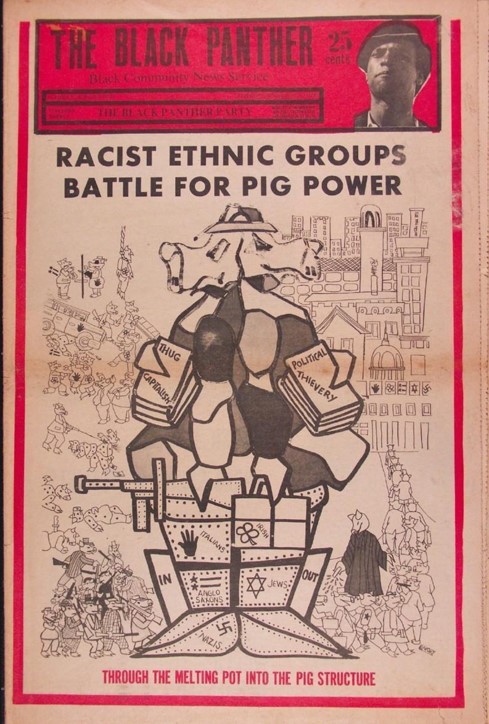
The Black Panther: Intercommunal news service
The Black Panther, the official Black Panther Party newspaper. Founded in 1967, the newspaper was published primarily as a weekly periodical during the late 1960s and early 1970s. It largely circulated in the United States and was published in English. It was produced by the Black Panther Party and operated as both a party newspaper and a revolutionary political tool.
The Black Panther Party, originally Black Panther Party for Self-Defense, was a Marxist-Leninist political vanguard deeply rooted in collective action and solidarity with oppressed groups. Their activism spanned the fight against U.S. imperialism and the war in Vietnam, support for Latino liberation, and advocacy for women’s and LGBTQ+ rights. Notably, the Party was also one of the first, and few, American radical organizations to demonstrate strong solidarity with Palestine. This paper examines the official Black Panthers Party newspaper as a revolutionary periodical and a tool of internationalist politics by focusing on its representation of the Palestinian struggle during the late 1960s and early 1970s.
In 1970, Black Panther Party co-founder Bobby Seale was exiled and invited to the Pan-African Cultural Festival in Algiers, Algeria, which subsequently led to an international Panther office in the city. Following that, the Panther newspaper dedicated an international section to global affairs, including multiple coverage of the Palestinian struggle. The study explores how through the newspaper, both movements developed a shared language and framework for resistance against imperialism, racial oppression, and liberation struggles. The newspaper overall is situated within the broader history of Third World liberation movements. The Black Panther functioned not only as a medium of information but as a tool of political education and transnational solidarity. The articles found in the newspaper framed resistance under different contexts: by linking U.S.-Israeli imperialism, publishing accounts of the situation in Palestine, and highlighting instances of armed resistance. These shared narratives resonate deeply with the BPP’s ideology on the principle of “In Defense of Self-Defense” and aligning with their Marxist-Leninist philosophy. As Black Panther Party co-founder Huey P. Newton quoted Mao Tse-Tung: “In order to get rid of the gun it is necessary to take up the gun.” In other words: “When the people move for liberation, they must have the basic tool of liberation: the gun.”
This echoes the words of Yaser Arafat, founder of Al-Fath party and the Palestine Liberation Organization (PLO), in an article reprinted from Free Palestine in The Black Panther: “In order that Arab people rid themselves of the gun, they must learn to use it first.” Within this shared revolutionary language, armed resistance fighters, often referred to as “Freedom Fighters”, are born.
Lea is a Beirut-born poet and writer working across Arabic, French and English. Co-Founder of Al-Karmel Association for the Al-Karmel Art Gallery in Toulouse, France. Currently pursuing an MA in Foreign and Regional English Languages, Literature, and civilization, with a focus on gender and feminist studies.