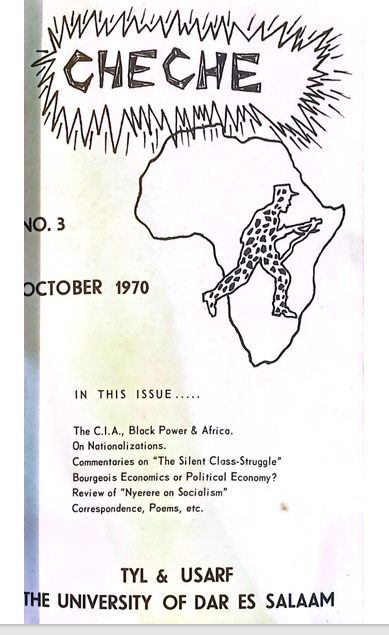
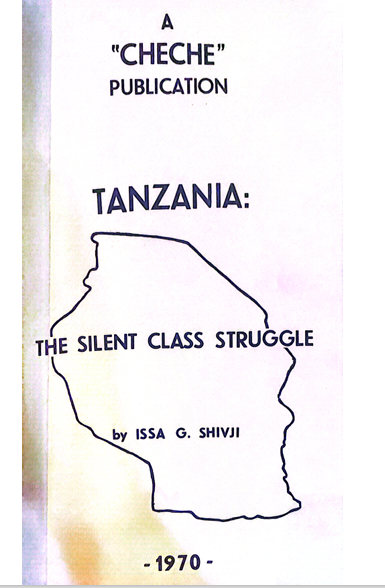
CheChe
CheChe, the English-language magazine of the University Students’ African Revolutionary Front (USARF) at the University of Dar es Salaam (UDSM). Published between 1969 and 1970 in the aftermath of the Arusha Declaration, CheChe functioned as the intellectual organ of a radical student movement committed to socialist transformation and Pan-African liberation. Produced by volunteer students and circulated beyond the campus, the magazine was banned after only four issues following sustained criticism of bureaucratic practices within the Tanzanian socialist experiment. Its suppression curtailed its immediate circulation and rendered it a fragile and partial archive of student radicalism.
CheChe carved out an independent space for theoretically grounded socialist critique within a constrained public sphere that limited robust debate on the implementation of socialism. Despite numerical weakness and institutional opposition, radical students used the magazine to debate national policy, interrogate bureaucratic contradictions, and press the state to uphold its professed socialist ideals. In doing so, they established a counter-public that sustained critical engagement within the postcolonial project.
CheChe operated as an organizational apparatus that structured, disciplined, and amplified the intellectual activity of USARF activists. It translated internal discussions and political education into printed intervention. Its editorial processes, based on a low-budget, volunteer production, and collective authorship model, bound individual contributions into a unified front of intellectual struggle. Through empirically grounded and prescriptive interventions on a variety of subjects, radical students localized socialist theory, scrutinized bureaucratic practice, and articulated proposals aimed at deepening Tanzania’s socialist transformation and advancing broader global and continental struggles. Circulation beyond the campus extended the reach of student thought into national and transnational arenas, as part of a broader political struggle.
While CheChe mobilized youth intellectual energies and pressed society toward fidelity to its emancipatory commitments, its critique remained anchored within a modernist socialist framework aimed at perfecting rather than transcending the limitations of modernist postcolonial state-building. What endures in the archive records the limited horizons of critique that were possible at the time, reflecting how revolutionary print cultures were both vehicles of imagination and objects of containment. Yet, without romanticizing the magazine or fetishizing its actors, CheChe nonetheless offers important lessons for contemporary youth movements in Africa: intellectual independence, theoretical grounding, collective discipline, and a Pan-African outlook.
Trevor Lwere is the chairperson of the Pan-African Youth Conference which brings together young people from across the continent and the world to critically study Africa’s development challenges. He is a member of the Advisory Board of the African Leadership for Governance Network. He is the author of Visions at Dusk, a handbook for African […]