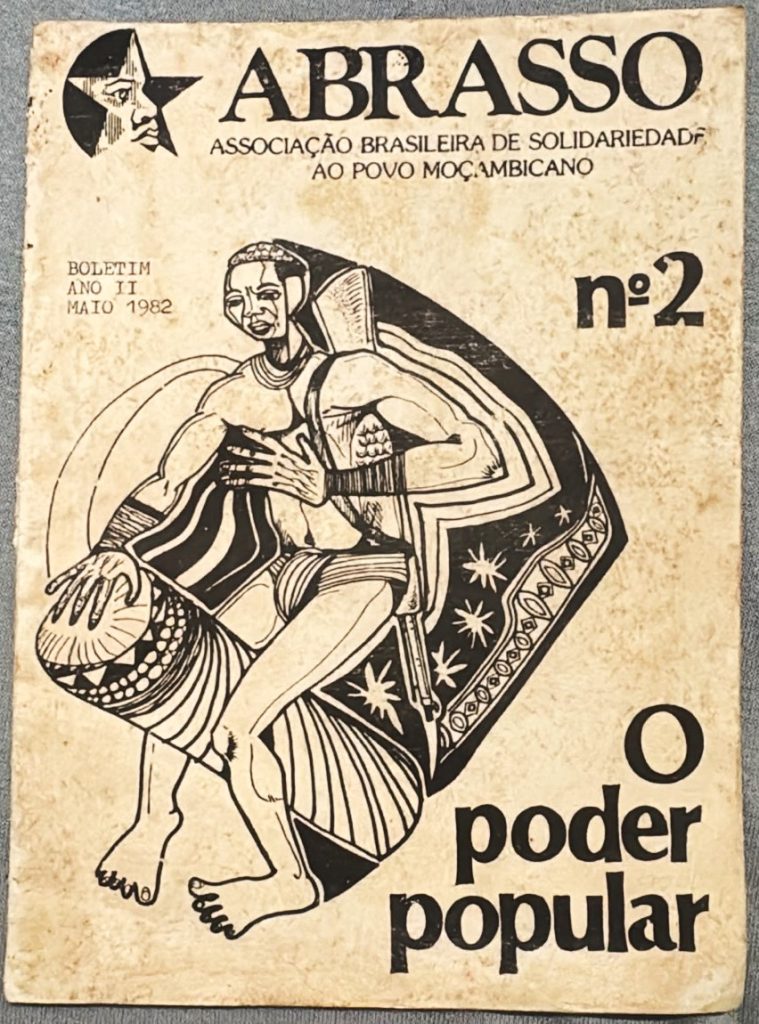
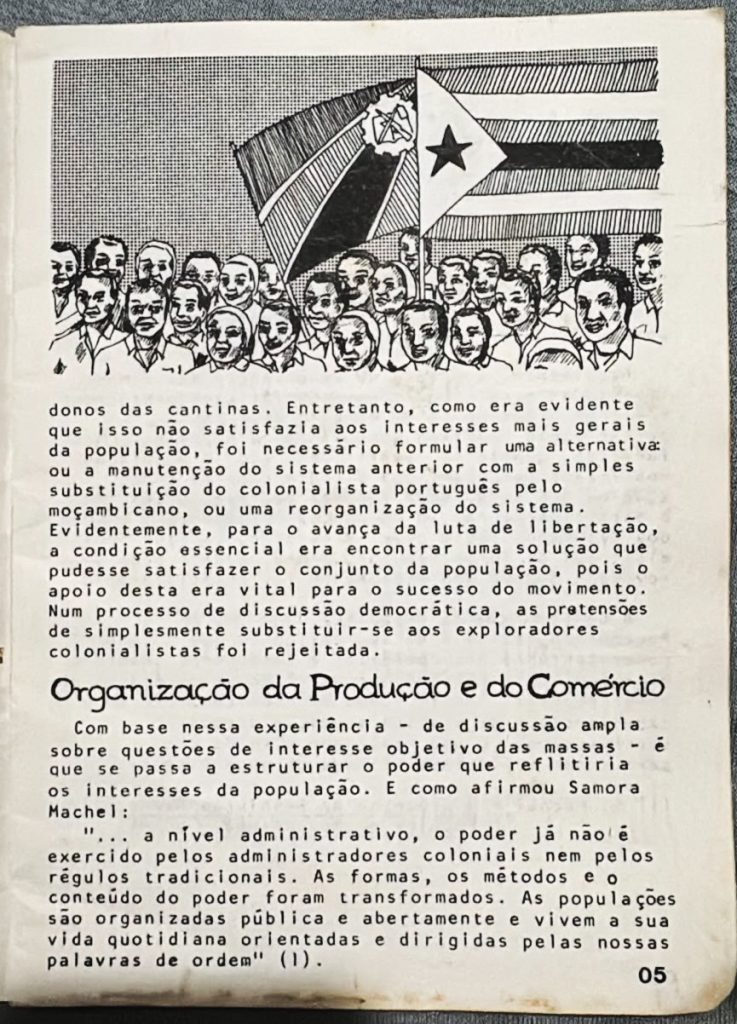
Boletim da ABRASSO (Bulletin of the Brazilian Association for Solidarity with the People of Mozambique).
The ABRASSO Bulletin (Associação Brasileira de Solidariedade ao Povo Moçambicano) can be described as a key artifact of “informational militancy” within the Brazil–Mozambique corridor of solidarity. The publication emerged from the experience of the cooperantes: specialists (doctors, engineers, teachers, among others) who, motivated by ideals of international solidarity or by political exile, were recruited by the Mozambican state to sustain critical public services within post-independence development projects, following the massive colonial exodus that left the country with a severe shortage of qualified professionals after independence.
Produced in a self-managed manner in the city of São Paulo (Brazil) by returned former cooperantes and militants active in Maputo (Mozambique), the Bulletin functioned as a “resonance box” for the Frelimo Revolution (Frente de Libertação de Moçambique) during the early years of its socialist transition, within a Brazil still operating under the shadow of military dictatorship.
The research focuses on the “material moment” of 1981–1982, analyzing the physicality of the Bulletin as a tool of resistance. It was a small and lightweight object (15 × 20 cm, fewer than 25 pages), featuring typewritten or hand-drawn texts that intentionally emulated the aesthetics of guerrilla propaganda pamphlets and clandestine anti-colonial literature circulated by Frelimo during the 1960s. The Bulletin sought to challenge the informational void and historical simplification produced by Brazil’s mainstream press regarding African liberation struggles. It not only translated Mozambican political concepts into a language intelligible in Brazil, but also articulated a shared grammar against racism, imperialism, and apartheid, linking Brazil’s Black Movement (MNU) to the construction of the “New Man” in Southern Africa.
The present-day access to these documents raises a critical discussion about archival diaspora and the state’s management of militant memory. On the one hand, the Bulletin survives within the surveillance files of the political police, preserved at Brazil’s National Archives and within the Memórias Reveladas project. Its issues were seized by the state in the early 1980s under the logic of “national security” and are now part of the documentary corpus released to the public as a result of memory policies implemented during Brazil’s redemocratization.
On the other hand, outside the institutional sphere, these materials resurface contingently in second-hand bookstores, as a result of the dispersal or destruction of personal archives belonging to deceased ABRASSO militants. This fragmentation brings to the fore a fundamental question regarding how “national” archival frameworks are imposed upon objects that, by their very nature, belong to transnational networks of support.
Julimar Mora Silva is a historian and postdoctoral researcher at the Institute of History, Universidade Federal Fluminense (Brazil), whose research focuses on Cold War internationalisms, Brazil–Mozambique connections, and the intersections of anti-imperialism, development, race, and class in the Third World. She is also the founder of the Third World Cosmopolitans project. Instagram: @julimarmora.s | @twcosmopolitans