
Chris Hani portrait (from Dawn Souvenir issue, 1986)
Chris Hani was a leading member of the ANC, the SACP, and MK, rising from the rank-and-file to become the second most popular leader of the Congress Alliance after Nelson Mandela. Alongside Thabo Mbeki he became the youngest member of the ANC National Executive Committee in 1975 and dedicated his life to the military overthrow of the apartheid regime. Hani was born in 1942 into what he described as the “extreme poverty” of the rural Transkei, 1Reiner Leist, interview with Chris Hani, 1992 (Wits Historical Papers (WHP), University of the Witwatersrand, A3395). was pursued throughout his life by a violent apartheid state while serving in the command structures of the South African Communist Party (SACP), the African National Congress (ANC), and the Umkhonto we Sizwe (MK), and survived a number of attempts on his life before he was ultimately assassinated outside of his Dawn Park home by Janus Walus on 10 April 1993.
During their Truth and Reconciliation Commission (TRC) hearing, Walus and Conservative Party MP, Clive Derby-Lewis, stated that they had carried out Hani’s assassination in order to destabilise negotiations between the National Party government and organisations aligned with the anti-apartheid struggle, and to plunge South Africa into civil war. Indeed, news of his assassination almost had this effect. According to popular accounts, it was only Mandela’s live televised address to the nation that calmed the situation. Hani’s assassination is therefore remembered as one of the pivotal moments in the transition to democracy. Not only was this because of its immediate after-effects, but also because after this event, the ANC under Mandela’s leadership, was affirmed as the new sovereign power, the only organisation that could manage the diverse interests of the Tripartite Alliance and the South African people and establish peace in the postapartheid. Hani, however, remains a contested figure today. For those aligned with the ANC’s post-apartheid project, Hani has become a symbol freedom and of the sacrifices made by the ANC during the anti-apartheid struggle. Whereas for others, Hani’s revolutionary legacy haunts the ANC’s post-apartheid project and unsettles the ANC’s triumphalist narratives. These latter issues are discussed extensively in the author’s PhD dissertation, but will also be touched upon toward the end of this teaching tool.
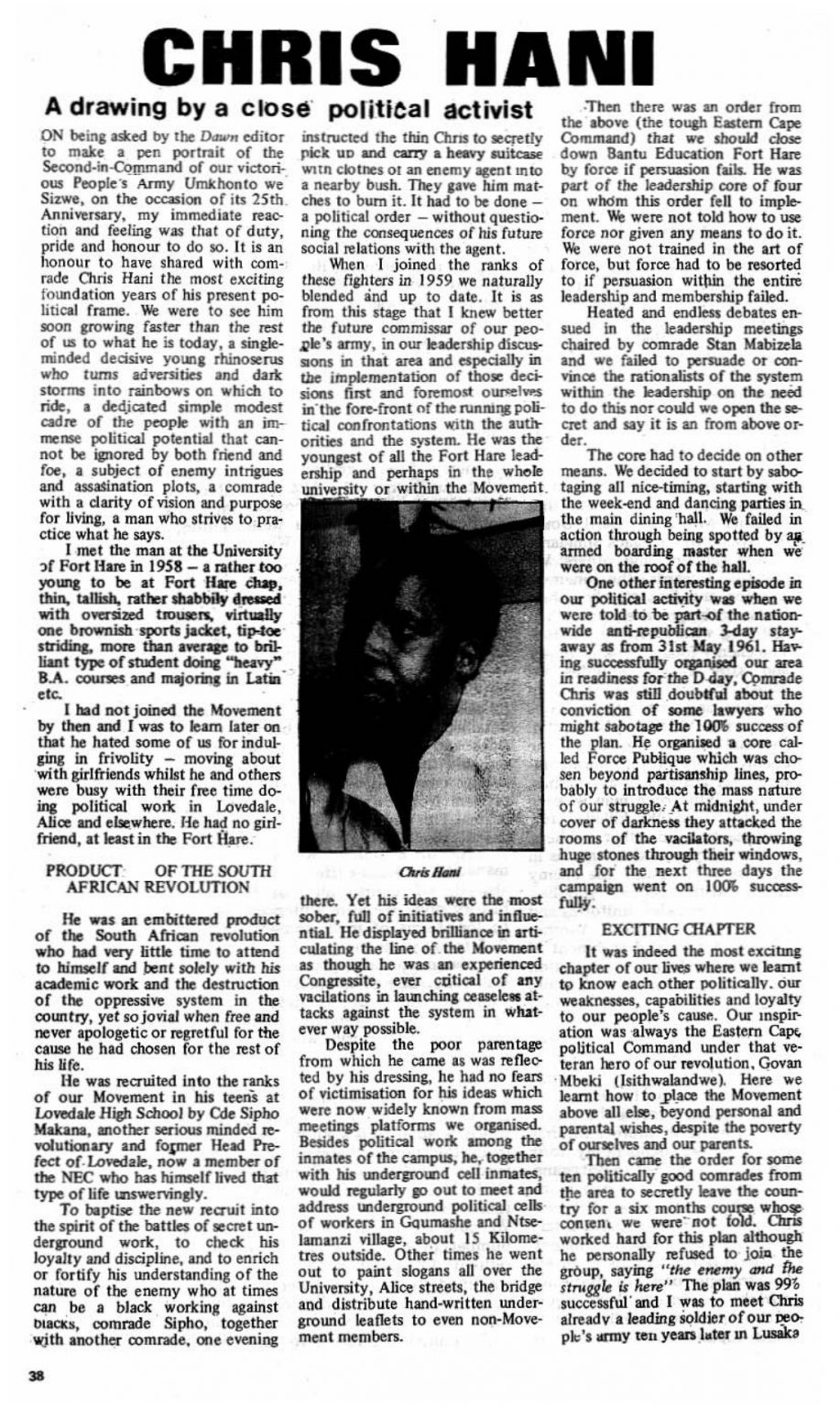

▴ From Dawn Souvenir issue, 1986. Courtesy of Digital Innovation South Africa https://disa.ukzn.ac.za.
- Reiner Leist, interview with Chris Hani, 1992 (Wits Historical Papers (WHP), University of the Witwatersrand, A3395).→