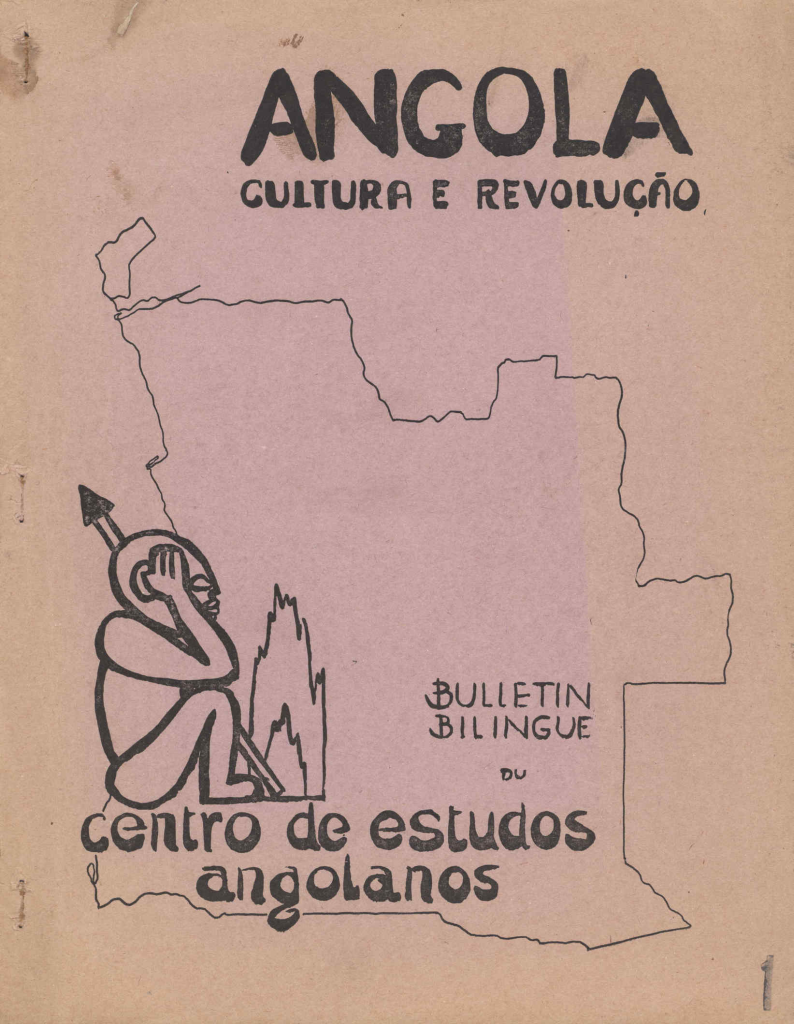
Angola. Cultura & Revolução
Issued in a total of six numbers, the bulletin of the CEA – Centro de Estudos Angolanos [Center for Angolan Studies], Angola. Cultura & Revolução [Angola: Culture & Revolution], was published in Algiers between 1964 and 1966. The choice of location is significant as the city – which Amílcar Cabral had renamed the Mecca of revolutionaries – was a key hub where anticolonial militants, artists, and fighters from all over the world gathered to organize the struggle. The institution responsible for its publication, the CEA, was founded in 1964 to advance the propaganda efforts of the MPLA (Movimento Popular de Libertação de Angola [People’s Movement for the Liberation of Angola]) as part of the broader international campaign that the movement conducted to mobilize support against Portuguese colonialism in Africa. As stated in the first issue of the bulletin, the CEA aimed to collect all kinds of printed materials that could provide “a scientific basis for the Angolan armed struggle”. It also sought to contribute to the education of MPLA militants and other Angolan refugees scattered around the world, while drawing global attention to the cause of the Angolan people and their heroic struggle. This internationalist stance explains why the bulletin was published in both Portuguese and French – the latter being a more widely used international language that enabled its circulation not only in Algeria, but also in other French-speaking African countries and in Paris, a major center for the Black intelligentsia during the twentieth century.
Daniela Spina (Ph.D in Comparative Studies, 2020) is a Junior Researcher at CHAM – Centre for the Humanities, NOVA University of Lisbon, where she carries out the project “Narrating the Young. A Comparative Study on Representation and Self-Representation of Colonial Youth in South Asia and East Africa: from Colonial Press to Postcolonial Fiction (1930- 1970)”. From 2021 […]
Elisa Scaraggi (Ph.D in Comparative Studies, 2020) is a Marie Skłodowska-Curie Fellow at the IHC – Institute of Contemporary History, NOVA University of Lisbon, where she works on the history of the Angolan liberation struggle through the lenses of culture and intellectual history. Her current research, funded by the European Union, centers on the personal […]