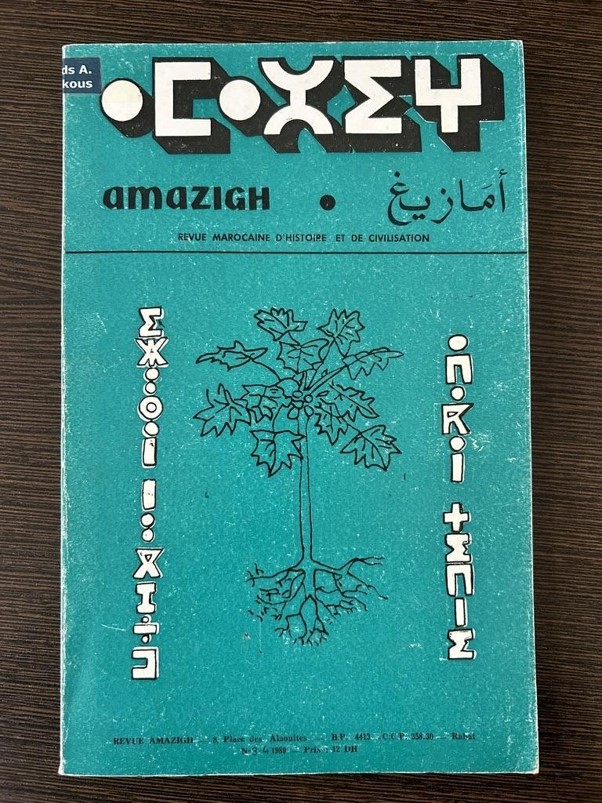
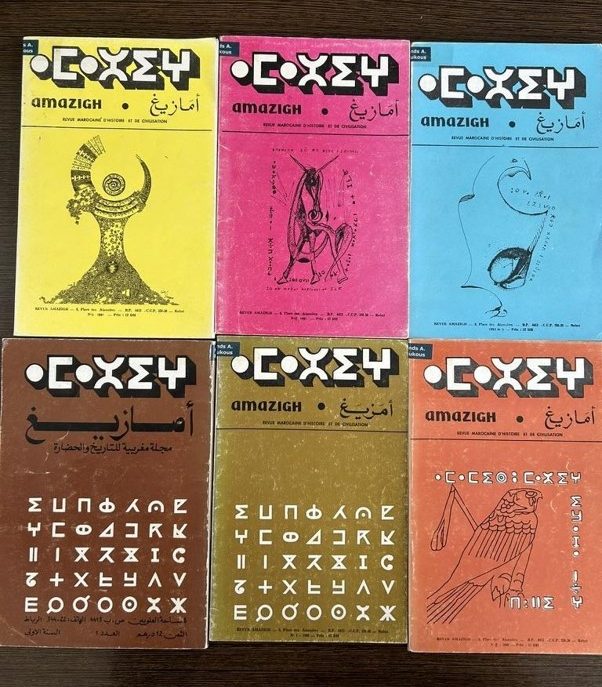
Amazigh: Revue marocaine d’histoire et de civilisation
The 1970s and 80s witnessed a renaissance of indigenous culture in North Africa, as Amazigh (sometimes called “Berber”) intellectuals and activists sought to revive their language and traditions. This cultural activism took on subversive and even revolutionary tones, as it challenged the dominant Arab-Islamic nationalism of the region’s authoritarian governments. In Morocco, the Amazigh movement was spearheaded by the Association marocaine de recherches et d’échanges culturels (AMREC) which began publishing Amazigh: Revue marocaine d’histoire et de civilisation in 1980. The journal’s primary contributors, including politician Mahjoubi Aherdane, poet Mohammed Khaïr-Eddine, and graphic designer Aissa Ikkan, were polymath intellectuals deeply engaged in the postcolonial francophone currents then sweeping the continent (AMREC’s 1981 conference featured an appearance from Senegalese president Leopold Senghor). Featuring a mixture of poetry, short stories, anthropological studies, and language instruction, the journal attempted to foster national consciousness by demonstrating the artistic and intellectual feats of an Amazigh civilization stretching back millenia. Written in a mixture of French, transliterated Tamazight (the indigenous language of North Africa), and a modernized local alphabet called Tifinagh, Amazigh shows in real time how local writers were attempting to work out the difficulties of fostering a reading public in multilinguistic, post-colonial North Africa.
Ironically, the editors’ turn to Arabic would coincide with its demise. When in 1982 the poet-historian Ali Sidqi Azaykou, writing under a pseudonym, published an article attacking the region’s Arab nationalist historiography in the journal’s tenth edition (and first written in Arabic), the Moroccan police imprisoned Azaykou and banned Amazigh. This episode, coming at the height of Morocco’s notorious Years of Lead and the bloody suppression of the Berber Spring protests in neighboring Algeria, marked a nadir in the Amazigh movement’s relationship with the Moroccan state. The coming decades would witness a rapprochement, as the state moved to co-opt indigenous activists. The new government of King Mohammed VI (r.1999 – Present) has embraced Morocco’s African, Jewish, and indigenous heritage. The state superseded AMREC with the founding of a Royal Institute for Amazigh Culture (IRCAM) in 2001 (led by Amazigh contributor Mohamed Chafik), the adoption of Tamazight as an official language in the new constitution of 2011, and the sponsoring of a number of regional festivals dedicated to Amazigh music and folklore. These developments have led to mainstream acceptance of indigenous culture in Moroccan society, even as they have sapped much of the anti-authoritarian and anti-colonial nationalist impulses which motivated the movement’s founders. As such, Amazigh reveals the obscured subversive history of Morocco’s indigenous
present. It remains difficult to access, available in private collections but mysteriously missing from the shelves of the National Library and National Archives. As the Moroccan state cultivates soft power through football diplomacy and stylized depictions of indigenous culture, Amazigh can remind readers of the violent history lurking behind this image.
Benjamin Jones is a PhD candidate at Georgetown University, where he studies the history of social movements and popular music in the Maghreb. He is currently researching a dissertation about the transnational Maghrebi music scene of the 1970s and 80s, which connected Kabyle folksingers, rai chebab, and Ghiwani bands across Morocco, Algeria, and France. His […]